
What no one saw coming as the first bombs dropped on Iran is the reality that modern warfare is more than military hardware and the will to fight. War is now about how fragile the global economy is where the price of victory is measured not by the tanks destroyed but by the price at the gas pumps.
The Choreography of the Strait of Hormuz: Lessons in Modern Warfare and the Global Economy
by Martín Paredes
April 11, 2026
On the morning of February 28, the war began not with a single defined image like wars of the past but with a cascade of missile streaks across the skies played to captivated audiences across television and digital screens launching an era of modern warfare that had been building up to this point in recent months. As airfields and traditional war machinery like artillery, missile launchers and airfields and their accompanying aircraft laid inert as the dawn arrived, the day of modern warfare had arrived.
Israel and the United States seemingly acting in concert but not entirely in lockstep had ended years of diplomacy to enact their goal of degrading Iran’s power projection capabilities and dismantle their nuclear capability through force. Washington officials spoke in the language of necessity while in Jerusalem the language was one of survival. For its part, the language of Tehran was simply about endurance, sovereignty and the long memory of grievance.
The first days of the war favored the attackers. Iran’s conventional forces were no match for the global power looking for regime change. Iran’s conventional military, its air force, fixed installations, and visible infrastructure absorbed the shock and, in many places, failed to recover.
But today’s wars do not resolve themselves in the neat arithmetic of destroyed military hardware and crumbled runways. Iran retained something less visible and more enduring, roughly half of its regional ballistic missile capabilities, its practiced doctrine of asymmetric warfare, its fleets of drones, and, most consequentially, its stockpile of nuclear materials. It had lost the body of a conventional force, but not the nervous system that allowed it to act unpredictably and globally.
Iran’s trump card was what it always said it would be - the Strait of Hormuz and its impact on the global economy.
The Strait of Hormuz
The tankers still move, but they do so with a kind of wary choreography, as if the water itself has memory. The Strait of Hormuz - narrow, indispensable, tense - has long been less a passage than a pressure point, where the global economy and regional politics compress into a channel barely twenty-one miles wide at its tightest. Here, roughly a fifth of the world’s oil passed each day, not in a smooth, anonymous flow, but in a procession shaped by risk, surveillance, and the constant possibility of disruption.
On paper, the Strait is a maritime corridor governed by international law. In practice, it is something closer to a theater. Iran sits along its northern edge, its coastline curving around the water like a hand poised but not ready to squeeze tight, until it was forced to do so to end the bombs falling on its cities. Across from it, the Arabian Peninsula rises with its ports, pipelines, and export terminals - Saudi Arabia, the United Arab Emirates, and others whose economies depend on these shipments continuing uninterrupted, and from which the global economies hum across the world.
But Iran did not need to close the Strait entirely, it merely needed to make its passage uncertain. Except for Iran, no one knew for certain if the waters were mined with anti-ship mines. The illusion is enough to send shudders through ship masters and ship owners alike. In effect, Iran did not capitulate. Instead, it did what it always said it would do - control the passage where much of the global economy transits. In doing so, it demonstrated a lesson that strategists had debated in theory but rarely seen enacted at such scale - that standoff warfare - precise, technologically sophisticated, and geographically distant - will fail against an adversary willing to embed the global economy itself into the battlefield.
The United States and its allies used to maintain a visible, if often shifting, naval presence in the region, ostensibly to guarantee freedom of navigation, but also as a signal to Tehran, to global partners and to the global market. Until it didn’t. America shifted away from keeping the peace on the Strait of Hormuz to dropping bombs, along with its partner, Israel, in the hopes that standoff warfare would be enough to change the reality of the region forever.
It has, but not in the way that the American people envisioned.
What made Hormuz so volatile is not the geography, but the way it amplified every political tremor. Sanctions imposed on Iran, for example, do not remain abstract financial instruments; they reverberate here, where Iran had repeatedly hinted that if it cannot sell its oil, others might struggle to do so as well. The threat was rarely explicit, rarely carried out in full, but it lingered in the background of every transit. Even small incidents like a seized tanker, a drone shot down, a close naval encounter would ripple outward, nudging oil prices, rattling insurers, and reminding the world how fragile this artery is.
Before the bombs began to drop last month, tensions had settled into an uneasy pattern - not quite crisis, not quite calm. Iran continued to develop its regional influence, often through indirect means, while the United States and its partners would recalibrate their presence, sometimes pulling back, sometimes reinforcing. Meanwhile the global demand for energy remained stubbornly high, even as conversations about transition and sustainability grew louder. The result was a paradox - the world spoke increasingly of moving beyond oil but remained deeply dependent on a chokepoint that can be disrupted with alarming ease.
For the people who live along these coasts, the Strait is not an abstraction. It is a daily horizon, a place where fishing boats share water with supertankers, where military exercises can unfold within sight of coastal towns, where the line between routine and crisis can blur without warning. The global narrative tends to flatten this complexity into charts and headlines - prices rising, shipments delayed - but the lived reality remains more granular, more precarious.
War planners had theorized about the economic impacts and Iran’s ability to close the Strait but at the end of the day, for the military planners, it was the raw arithmetic of naval assets destroyed and runways obliterated that governed their thought processes while the abstract thoughts of world economies being brought to their knees were inconsequential to beating a longtime adversary into submission. Most didn’t even contemplate the political dynamics for the November elections that the bombs changed as they hit their targets in Iran.
To write about the Strait of Hormuz is to write about interdependence under pressure. It is a place where geopolitics becomes tangible, where decisions made in distant capitals manifest as tension on the water. And for all the talk of transition, of new energy futures and shifting alliances, the Strait remains what it has long been - a bottleneck through which power, anxiety, and possibility must pass.
The New Global Order at the Strait of Hormuz
Today, on the surface the waters of the Strait are calm but in transition. Calm because the transit of global energy is frozen in place. In transition because the war has proven that the Strait is the Achilles heel for the Superpowers hoping to reshape the global order of the Middle East through standoff warfare.
The tankers keep moving - albeit at a trickle - unable to keep feeding the energy needs of the global economic engine threatening to destabilize not just the Middle East but the world’s economy as well. They glide through designated lanes, guided by satellites and watched by navies, carrying crude that will be refined, traded, consumed, and eventually burned.
There is an increasing sense that Hormuz is not just about energy, but about the architecture of a shifting global order. As new global powers assert themselves and old alliances are strained, the Strait is now the testing ground for global influence. China, for instance, has deepened its economic ties with Gulf states and maintains a strong interest in the uninterrupted flow of oil through these waters. Regional actors were hedging, diversifying their partnerships, seeking autonomy while still relying on external guarantees for security, that is, until the reality of the bombs set in.
Today’s Strait of Hormuz is not what it was. It remains the choke point for the global economy with the country the Superpowers hoped to slay with bombs closing its fist around it asserting control over it, and upending decades of a delicate balance between power and the needs of the global economy.
Within days of the first bombs dropping on target, the cost to the United States alone approached twelve billion dollars - a figure that would later come to feel like an opening bid rather than a total. The broader toll proved harder to calculate but impossible to ignore. Roughly three per cent of global GDP was placed in jeopardy, an estimated five hundred and ninety billion dollars evaporated from the world economy in the early phase of the war. Oil prices surged, dragging inflationary pressures behind them like a wake. Commodities traffic through Hormuz dropped sharply, not to zero but to a trickle calibrated by risk.
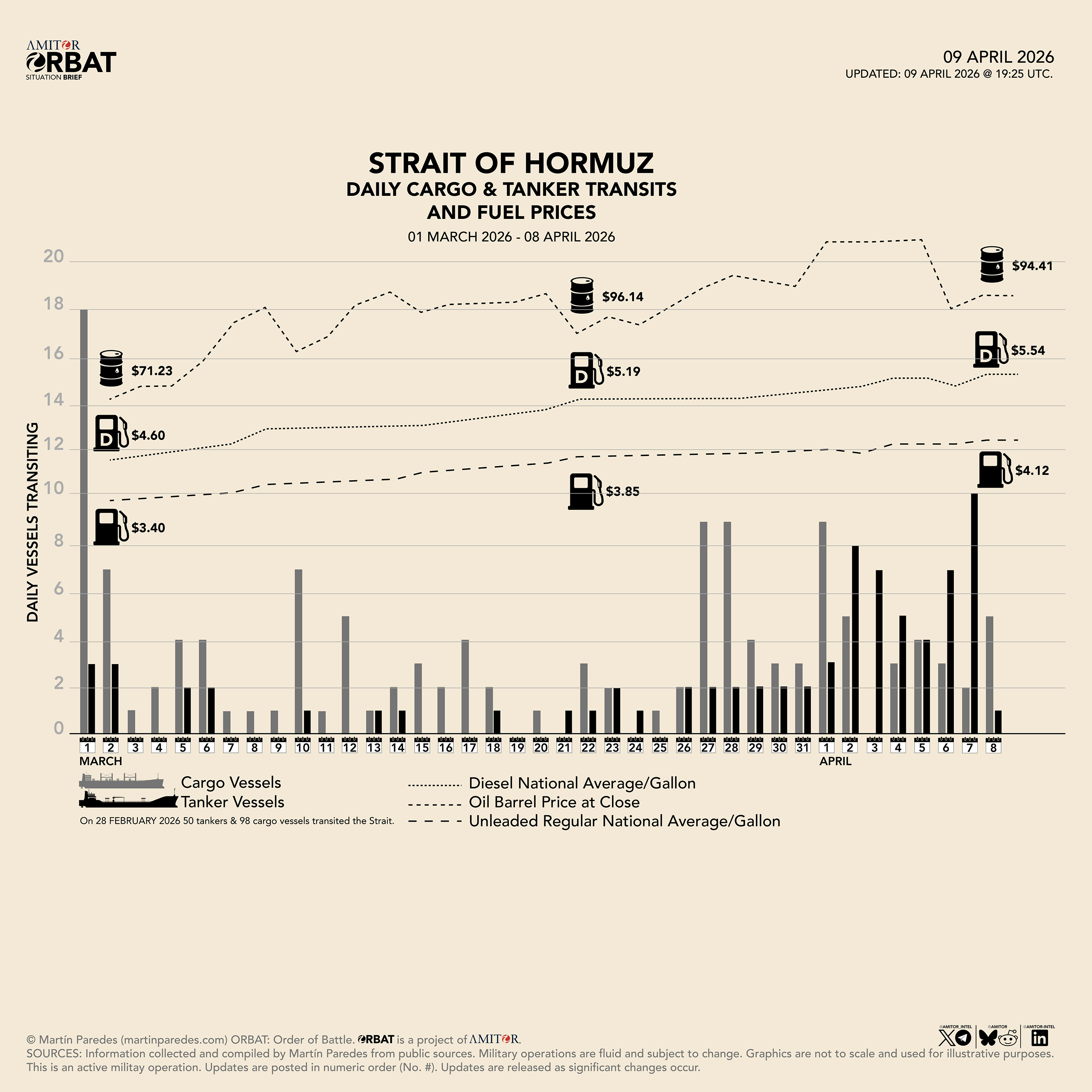
The financial architecture that underpins American power began to show strain. The petrodollar system - long the quiet pillar of U.S. borrowing capacity - relies on the steady, dollar-denominated flow of oil. As that flow faltered and alternative arrangements, particularly those denominated in Chinese yuan, gained traction, the cost to the American borrowing edged upward putting pressure on the American economy. It is not a collapse, but rather, a subtler and perhaps more unsettling gradual erosion of assumption.
By early April, exhaustion had set in, though not evenly distributed. On April 8, the United States and Iran agreed to a two-week ceasefire, a pause that felt less like resolution than the short respite it is. Today, officials from both countries meet in Pakistan to begin peace talks that is an arrangement that is notable as much about who is absent as for who is present.
Israel, which participated in the initial strikes, is not part of the direct negotiations.
The Absence of Israel
Israel’s absence from the direct peace talks is silence that is unsettling to many. Publicly, American officials frame the talks as a bilateral necessity, a way to reduce immediate tensions and establish a framework for de-escalation. Privately, analysts speculate about what Israel’s absence signifies. One interpretation is tactical - that Washington wants flexibility, unencumbered by the harder lines Jerusalem might insist upon. Another is strategic - that the United States is, however cautiously, testing a post-conflict regional order in which it can engage Iran directly without the constant triangulation that has defined talks in the past.
For Israel, the risks are evident. To have struck Iran and then to be excluded from the table where terms are set is to relinquish a measure of control over the outcome. It raises the possibility - still speculative but increasingly discussed - that the end of this war could involve arrangements that prioritize broader stability over the specific security concerns that drove Israel’s participation in the first place. For Iran, the optics are favorable because it allows it to negotiate with the world’s preeminent power as a sovereign equal, even after suffering significant military losses.
The Iranian Gambit
Meanwhile, on the water, a different negotiation is underway. Iran now effectively controls the tempo of the Strait of Hormuz, not through formal declaration but through demonstrated capability. Its signals have been consistent - any durable end to the war will include a role for Iran, and, intriguingly, Oman, in managing the strait, with transit fees helping to offset the damage inflicted on Iran’s infrastructure. Such an arrangement would mark a profound shift, transforming a global commons into a partially monetized corridor governed by Iran, and possibly Oman.
How long would it take to reverse the damage if peace were declared tomorrow? The physical infrastructure of oil transport - tankers, ports, pipelines - can be repaired or repositioned at relative speed, perhaps within three to six months for flows to approach pre-war levels. But confidence, which is the true currency of global trade, returns more slowly. Insurers, shipping companies, and energy markets would likely require a year or more of stability before fully normalizing their behavior. The global economy, having absorbed a shock of this magnitude, could take eighteen to thirty-six months to regain its previous trajectory, and even then, the path might be altered, and more diversified, likely more cautious, and less reliant on any single chokepoint like the Strait of Hormuz.
China’s role in this evolving landscape appears poised to expand. By positioning itself as an alternative economic partner and, potentially, a mediator less encumbered by the alliances that shape American foreign policy. Beijing stands to gain more influence across the Middle East as the reliable partner absent America. The incremental shift toward yuan-denominated energy transactions, accelerated by the war’s disruptions, reinforces that trajectory.
Political Consequences for America
For Americans, the war’s cost is more than rising prices at the gas pumps and groceries. The war is a reminder that America’s global prowess is insufficient to dictate policy through the intricate global supply chain that is the global economy. For America it is not simply bringing back manufacturing to the country. It is too late for that. But on the horizon there is a more immediate problem for the American political system.
The political consequences are only beginning to crystallize for Americans. With congressional midterms approaching, the war has introduced a volatile mix of factors - rising energy prices, questions about the true cost of the conflict, and a broader unease about America’s role in a world where economic and military theaters are increasingly intertwined. Incumbents face the challenge of explaining not only the rationale for the war but its cascading effects on household costs and global stability. Opponents, meanwhile, are likely to frame the conflict as both an overreach and a miscalculation, pointing to the resilience of Iran’s asymmetric capabilities as evidence that the initial objectives were flawed and incomplete.
What Will Peace Likely Look Like?
If the talks in Pakistan succeed, the most plausible end to the war will not resemble victory in any traditional sense. Instead, it may take the form of a layered compromise. This will include a verifiable reduction in Iran’s most threatening capabilities, nuclear bombs, and a formal or informal acknowledgment of its role in the security of the Strait of Hormuz. Particularly its defacto role in managing who transits the Strait. It is likely that the easing of hostilities will be tied to economic incentives. But Israel’s position would need to be reconciled, perhaps through parallel assurances or security guarantees brokered by the United States.
Such an outcome would be less a conclusion than a recalibration, a recognition that in an era where the global economy can be both target and weapon, the lines between battlefield and marketplace have blurred beyond easy distinction. The war that began in the skies over Iran may ultimately be decided in the shipping lanes, the currency exchanges, and negotiating rooms of the global economy.
As this essay was about to be published, news broke that two U.S. warships had passed the Strait of Hormuz, the first time U.S. naval assets entered the Strait since hostilities broke out.
The USS Frank E. Peterson and the USS Michael Murphy, two guided missile destroyers entered that Arabian Sea in a mission to clear the Strait of Hormuz of any mines in the water, according to U.S. officials. The plan, according to CENTCOM, is to open a new passage outside the one set earlier in the week by Iran.
However, Iran has said that the U.S. vessels retreated after being warned by Iran that they would be fire upon. A Greek vessel and two Chinese oil tankers are said to have transited the Strait as well. The passage of the U.S. vessels and oil tankers have not been confirmed by independent sources at the time of publication.
Coming This November
In a moment when headlines race past us and borders are drawn ever sharper in ink and rhetoric, a new voice is arriving to slow things down - and look again.
Amitor is a digital magazine built to reexamine the North American story through a Latino lens: not as an outsider’s view, but as an essential perspective that has always been part of the continent’s fabric. From the corridors of power in Washington to the factories of Monterrey, from migration routes to tech corridors, from trade negotiations to cultural shifts, Amitor traces the forces shaping Canada, México and the United States as a shared - evolving space.
Blending the analytical rigor of policy journals with the narrative depth of longform storytelling, Amitor will seek to do more than explain the news - it will aim to humanize it, question it, and connect it across borders.
This essay is a first glimpse into a Latino approach to news - stories grounded in current affairs, but told with the context, nuance, and lived realities that often go unseen.
This is just the beginning. Stay tuned.
About Martín Paredes
Martín is an immigrant from México, observing and expressing his experiences of seeing the world through the eyes of an immigrant trying to understand the chaos around him, one story at a time.
© Amitor is a publication of El Paso News.